Showing posts with label history. Show all posts

Monday, August 11, 2014

one-track mind


Outside of Mérida, Yucatán, along the road leading through Acanceh, past numerous tiny villages, lies the town of Cuzamá. Cuzamá is known today for its three cenotes (sinkholes) and attracts thousands of Mexican visitors every year, especially in the summertime. If you don't get confused and turn around on the way to Cuzamá, you will come upon a parking lot and a whole lot of tourists. From there, it only took us about half an hour for our horse-drawn carriage to arrive. Because about seven kilometers down a 150-year-old railroad track sit three pretty incredible cenotes. If you haven't had the pleasure of swimming in a cenote before, I highly recommend it. These freshwater sinkholes form when the limestone earth is fractured, allowing rainwater to seep into the fractures. The water running through these fractures dissolves more and more limestone until eventually caves form. Swimming in cenotes is one my favorite things in life.


Cuzamá wasn't always known for its cenotes. One hundred and fifty years ago, the Yucatán was at the center of henequen production. Haciendas, aka plantations, were erected all over the state and railroads were set up all throughout the peninsula. A horse drawn cart that runs on railroad tracks, called a truc, was the means of transportation used in the old haciendas during the 19th and 20th centuries.


Our truc arrived and I took my seat. I let the horse lead us along the track down the road to the cenotes. However, I quickly noticed, there was only one railroad track. One. I thought long and hard about this at first. One track, I thought. That must mean we all go in one direction at once and then all return at the same time.

Except that is not what happens. Every time we get a little momentum and rhythm going, another cart and horse appear heading straight toward us. So we quickly get off our cart, lift the truc and move it off the rails, wait for the other cart to pass, put our cart back on the track, and get back to it. This process continues like this every 5 minutes for 45 minutes.

I captured the art of moving the truc on and off the track to let the other carts pass

Why isn't there a second railroad track? I had to ask. My driver told me, "the railroad is 150 years old." Well, okay, that's amazing. But why not build a brand new track next to the old one and then in another 150 years you'll have one 300-year-old track and one 150-year-old track? The driver didn't seem to appreciate my additional questions.

But I couldn't just let my curiosity go. In 150 years did no one ever take the initiative to make life easier?

The answer is no. But I still wanted to find out why. Not surprisingly, the internet doesn't have any information about this. So I started to ask the locals. Why only the one track?

The answers soon started pouring in. One day the henequen just ran out. Voila, it was gone. And the haciendas? Abandoned. And the railroads? First, the iron was sold in pieces. Then the roads were paved over so cars and buses could drive on them. Modernism took over the 
Yucatán.

Henequen is a type of agave plant. The raw fibers from the henequen cactus are shredded, pulled, and wound together to make into rope for hammocks, twine for baling hay, and burlap bags.

Okay, this all makes sense, but if Cuzamá is still using the railroad track, why not invest the plentiful tourism profits into placing a second track? I thought this was a brilliant idea. But the locals had many logical explanations for me. First, the railroad track itself is over 150 years old. That means there is no more track of its kind. And furthermore, there are no local engineers. No one who would know how to place this type of track. I never thought of this before.

Also, there is some speculation that the people of Cuzamá are waiting for the Mexican government to give them the funds to improve the tourist route. There is no one in Cuzamá who will use his or her own profits or capital to add a railroad track when maybe some day the Mexican government will provide the support. Even if they have to wait another 150 years.

In the meantime, I'll head back to Cuzamá any chance I get. And its railroad track will retain its charm, as well as its place in history.

Wednesday, April 23, 2014

how to write an iBook - part 2

I went to the Yucatán with a mission; to write an iBook. Armed with Sue's secret iBook writing formula, I first needed to research the Maya. After I discovered the online history books were getting their facts wrong, I immersed myself in local Maya culture, people, and artifacts. After an in-depth trip to the Museum of the Mayan World, followed by a few trips to local Mayan ruins, I stopped by a few local villages to check facts with my new found Mayan friends. It was a lot of information. How was I ever going to remember it all?

A relic from the Mayan World Museum

A few years ago I discovered a helpful traveler's trick; to take photos of writing. Have you ever taken a photo of an amazing place, only to forget later what was in the photo? A quick helpful trick, thanks to the unlimited photo taking digital cameras allow, is to snap a quick photo of the item's description or marker. In the end, it's a very helpful way to remember. But in the meantime, it leaves me overwhelmed with the sheer number of photos I have to sort through.


The actual description of the relic pictured above!

Armed with photos, interviews, background and hard fact information, I was ready to sit down and write my iBook. But I was still missing one of the most important iBook parts; the community contributed artwork. This is an integral aspect of our interactive art iBooks. But my time in the Yucatán was running out.

I showed up at Dona Vero's Monday night Proyecto Itzaes group armed with an activity for the kids; draw your interpretation of the word "pyramid." Dona Vero repeated the assignment to anyone who arrived at the Proyecto, and I know she understood the gist of the assignment. We all have ideas of what pyramids look like. But instead of drawing a pyramid we've seen before, what would each person imagine? I thought this was a pretty simple assignment to start. And it would help me with my iBook.

I am thrilled to be able to add Chixculub Pueblo contributed artwork as I work on my final iBook product. But what you will see in the final product is not a crazy idea of a pyramid. Or even a different shaped pyramid. Every person (child and adult alike) who contributed artwork to the iBook all drew me the same pyramid: Chichen Itza. Some drew it from memory from books seen/read (no one had actually seen Chichen Itza up close), while others opened a Maya culture book and copied the pyramid exactly. I was astonished; where was the imagination?


Three versions of the same pyramid: Chichen Itza

The imagination was nowhere to be found. But this is not all that uncommon. The Mexican educational system is a very exacting one. Questions are asked, answers are written in black and white, and it's a very clear cut system. What I was asking for did not have a correct answer. But that was what I was given; a response that your interpretation of a pyramid must be Chichen Itza to be correct. And yes, their drawings were correct and I will use them in the iBook. But I was looking for anything but the ordinary. I was looking for a place where imagination took over and there are no wrong answers. Where was the inquiry? Where was the imagination? Where was the ability to let go of the belief in one right answer?

I guess I have my work cut out for me.

Saturday, March 29, 2014

lost and found

In between meeting new people, visiting Proyecto Itzaes sites, and delivering books, I'm also learning. About a people and a culture that the history books are getting wrong. Why did the Maya disappear? Well, they didn't. Mayan people, culture, and language are just as alive today as they were hundreds of years ago. Did the Spaniards invade Mexico and massacre millions of Mayas? You bet they did. But they didn't exterminate them. The current scientific theory that the meteor that hit the earth and killed off the dinosaurs occurred where I'm sitting right now (on the Chicxulub Crater) is an example of extinction; what happened to the Mayas is not.

And thus, all my pre-trip research had gotten it wrong; there are many Maya, 2012 was not the end of the world, and the Mayan civilizations were not socialist. Then what, I thought, is the real story of the Yucatec Maya?

I started my current line of questioning at the beginning; seeing the ruins for myself. From Xcambo, to Dzibilchaltun, and finally to Uxmel, I think I'm beginning to learn an accurate thing or two. The research of ruins will culminate with two stops next week in Chichen Itza and Tulum. By then, I hope to know what I'm seeing without being told by a guide.

Uxmal, Yucatán

Next, I asked the people. I quickly learned a few key last names (Cen, Couoh, Kú) signify Maya. These are not just the decedents of the Yucatec Maya (who built the ruins I've been looking at) but includes all the current sects of Maya who speak the Yucatec Maya language today and keep many of the traditions. I still have a lot to learn about the different Maya sects and provinces.

I have also found some common trends, at least among the Maya of the Yucatán. I have heard many time about being sure to feed the Alux - a mystical being who guards your garden. Everyone knows that March 21 is the solstice and you can see a snake in the stairs of Chichen. But most of these same people (actually everyone I asked) have never actually been to Chichen. (And it's only about a 2 hour drive away). 

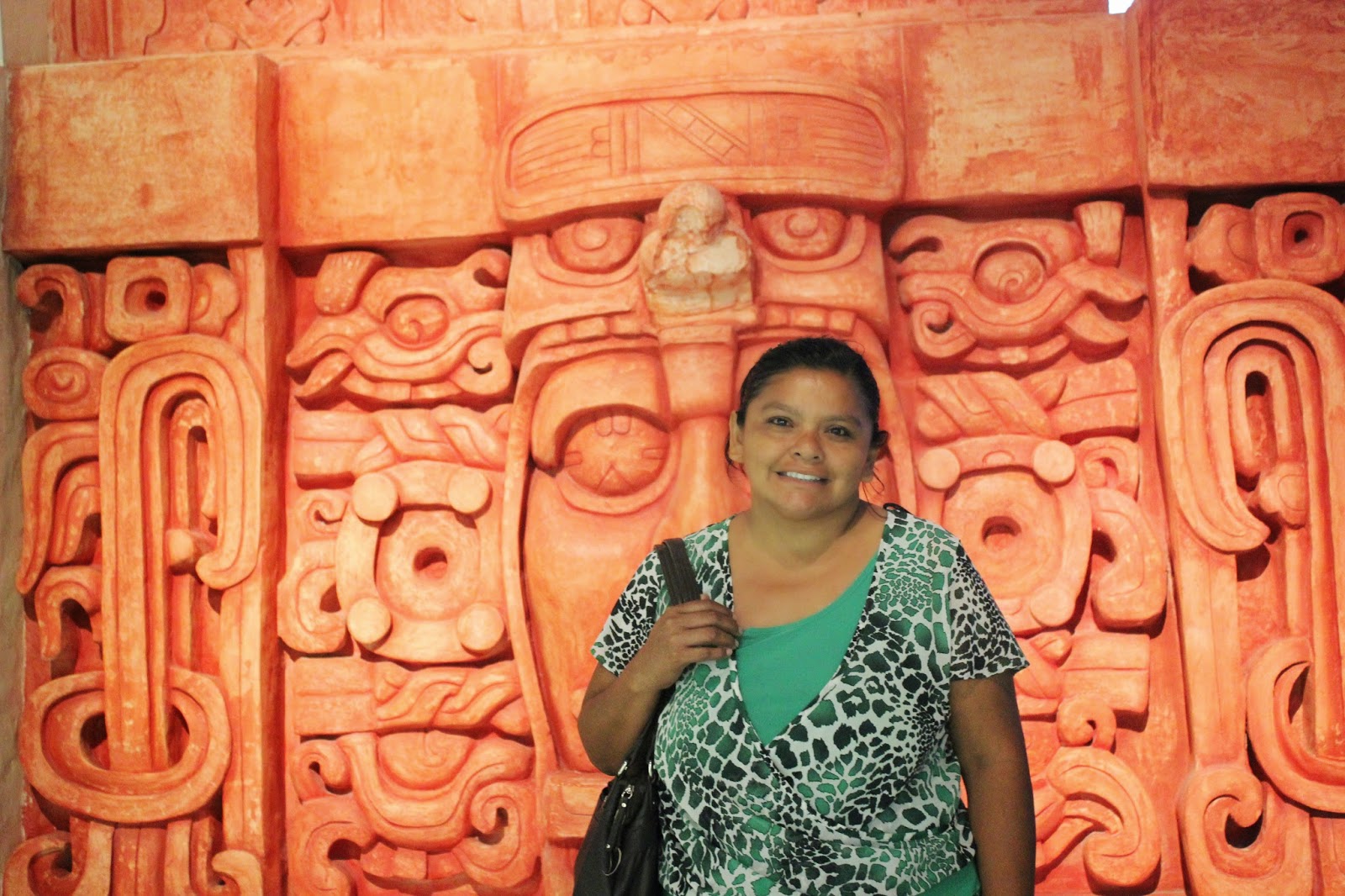
As I continued along my Maya educational journey, I went to a first rate museum (as I am a museum-goer in every city). The Gran Museo del Mundo Maya (Great Museum of the Maya World) covers the history of a local people. And, not only did I get to take in as much learning and history of Maya as I could stand in one morning, I was accompanied by my new friend, Proyecto Itzaes library supporter Veronika. Vero, who lives in Chicxulub Pueblo about 40 minutes from the museum, had never been. She was enthralled; Vero is Maya afterall. And while Vero's parents speak Yucatec Maya (which is a language option throughout the entire museum), she does not. Vero knew many things about the history and tradition of the Yucateco Maya, but she told me afterward she learned a lot at the museum.
Vero in the Gran Museo del Mundo Maya in Mérida, Yucatán

My hope is that Vero can take her kids to the museum next time. And that she and her family can some day visit Chichen Itza.

To learn more about Maya legends, I recommend this website: http://www.jaguar-sun.com/links.html