Showing posts with label proyecto itzaes. Show all posts

Wednesday, May 6, 2015

the end of the road

Veo al final de mi rudo camino, que yo fui el arquitecto de mi propio destino. 
I see at the end of my rough journey, that I've been the architect of my own destiny.
- Amado Nervo


I feel pretty comfortable driving in Mexico. Actually, I feel comfortable driving just about anywhere. And I'm almost always the driver. Rental cars don't bother me. I like getting to test drive different cars. Every time I've gone to the Yucatan to volunteer with Proyecto Itzaes, I've rented a car. And the only mishaps I've had have been regarding the actual renting of the car. No matter what time you arrive, the process of filling out the rental paperwork and getting to drive away in your newly rented car takes several hours. I don't exactly know why, but it just does.

This is how much Mexican country-side I typically drive through

But then, while driving through the Yucatan last month, my car rental luck ran out. A rock hit the car's windshield. And at the very most top part of the windshield, half on the plastic that seals the glass to the roof. But just low enough to embed itself at least partly in the glass. But just high enough that I didn't know that was the case. However, once the crack started to spread in a long line down the window, I realized exactly what had happened. In the five minutes it took us to get home the crack had successfully run the entire length of the windshield. And it was only getting longer. I panicked. I didn't know what to do. This had never happened to me before. Not even in the US. I once had a windshield bashed by some thugs with baseball bats in Potrero Hill. But never a rock in the windshield. I guess it was about time this finally happened to me.

I quickly tried to decide what should I do; get an estimate from a nearby mechanic and pay for the repair before the rental was due back? Or break down and call the rental car company, knowing it would be a long painful process. I knew I couldn't drive the car again, so I had to do something. I called the rental agency. They were so nice. Surprisingly nice. With amazing customer service. I had never experienced this before. I was still skeptical this would go off without a hitch, but the nearest car rental depot (not the one we originally rented from) would send a driver out to our home, bringing a replacement car for us. It sounded too good to be true. Especially because I had to head to a village for an appointment and wouldn't be home for a few hours. They assured me they would sent someone in a few hours. It would all work out.

When we go home from Dzemul, there it was; a brand new, identical but red (our first car was turquoise) rental car, along with two patiently waiting agents. Though I had arrived only five minutes past my scheduled time, it seemed like they had been waiting for quite a while. When I asked the rental agents the length of their wait they politely responded that they had been there for an hour. Yet they didn't seem restless. Perhaps they were enjoying the sun, sand, and ocean. Yes, they assured me, the windshield will need to be replaced. ¡Que mala suerte!

So there we were, new and improved rental car at our disposal. Which was convenient. Because we were planning to leave the beach, drive south a few hours to my favorite ruins (Uxmal), and many hours later arrive at Bacalar, situated just south of Playa del Carmen. On the other coast. It was about a six hour drive but we planned to make it into one long day of driving and sightseeing along the way. We set out very early in the morning.

And we were driving along just fine. Highway driving in Mexico is pretty self explanatory. The highways are nice and new, although mostly two lane. Since the speed limits are high (at least 110 kph), it's completely normal to pass slow moving vehicles. When the roads aren't curvy or dangerous. I'm a pro at passing cars on single lane Mexican highways. It takes a lot of patience, but you can always eventually pass.

Which is why I was very perplexed when I quickly came upon seven cars going slightly slower up ahead of me. They were clearly waiting to pass a slow moving van. Wow, I thought, they must have some serious patience to wait so long to pass. But in time, I knew, we would all make it safely past the slow moving vehicle. We had many many more hours to drive; we couldn't exactly afford to drive so slowly for a very long time.

None of the cars ahead of us were going particularly slowly, nor were they inching to pass the slowest car at the front of the line. I thought about it for a split second before heading on to pass the cars myself. There was no use in waiting, after all. Except that the roads through the Yucatan can be windy. So I wouldn't have enough time to pass all seven cars at once. I started passing them two at a time. I passed the first two cars. They seemed content to be where they were. Hmm, I thought, maybe they're driving in a line. I wonder why. I can't be sure, but it doesn't seem as if they are trying to pass the front car. So I quickly passed the next two cars, and then the next two cars. Eventually I was right behind the slow moving van. And that's when I saw it. The giant picture of the Virgin Mary staring right at me. It was posted conspicuously in the rear view window.

It looked like a regular covered truck to me

Because it was a hearse. Carrying a corpse to its final resting place. And we had placed ourselves prominently first in line at a funeral procession. I swallowed hard. Was what I had been doing wrong? Was I not supposed to weave in and out of a funeral procession? Was there some tell tell sign early on in this process that I had completely missed? Or did I not know what was going on until just that moment? And once I realized where I was, was it wrong to try to head out and pass the hearse? So I did just that. I waited for a clear view of oncoming traffic and sped over and passed the hearse. What else was I to do? They were going far and long; but they were also going slow. They didn't need me embedding myself in their mourning processional.

So we drove on. And on and on and on. We were going to take Highway 184 from Uxmal to the Caribbean coast. Highway 184 would meet up with Highway 307, the main road from Cancun all the way down to Belize. We'd hit into 307, turn right, and drive a few miles down the coast to Bacalar. We'd been driving for hours, but we started passing the signs telling us that 307 was just ahead.

According to Google Maps, Highway 184 bisects Highway 307

Which it probably was. But we'll never know for sure. Because we never merged onto Highway 307. We never go that far. Instead, we drove on Highway 184 until the road just ended. That's right, the highway just stopped. So we stopped. And then we looked around. There were people coming towards us on foot. They were walking over with suitcases and backpacks. They were getting into taxis. They were driving away, the only direction the road went - back to where we had just come from.

I found a narrow place to turn around. And then attempted to ask a taxi driver for directions. He and his friends laughed as us. The road didn't intersect with the coastal road, at least not yet. The road would be built, someday. I couldn't believe it. The maps/gps indicated we could drive right on through. Except that we could see right in front of us; there was no actual road. Only a parking lot. The taxi driver drew us a map; we'd have to backtrack for a while, then turn off and pass through three villages before finally hitting 307, south of where we were. But we would hit it eventually. In only a few hours time.

So then I asked about the people coming towards us, from what appeared to be the other, coastal side. No one could answer me. Apparently there was an airport some place nearby. But that didn't explain the cars and people I could see ahead of us, driving inland from the coast to meet us. Except we wouldn't meet. Because there is a strip of highway missing. That just hadn't been built. Instead of continuing on the way we had planned, we had made it to the very end of the road. So we turned around, drove back back, turned off at a random desvio, and ended up in paradise. Because that's what happens in Mexico. Paradise is always just one wrong turn away.

Bacalar

Thursday, April 23, 2015

a place in the sun

La sangre sin fuego hierve. Blood boils without fire
- Mexican Proverb

I've spent a little bit of time in Mexico recently. Actually, it's been quite a bit of time. Yet it's never enough. There are so many things I love about Mexico: the food, the ocean, the people. But I can't forget about the sun. In Mexico, the sun is an entity in and of itself. It calls the shots; when we wake up, when we go to sleep, how we spend our days. It has been both lovely for me as well as painful. My first trip to Mexico I burned my feet being out in the sun too long, and they swelled up into giant tomatoes. I learned my lesson.


I try to never miss a sunset when 
I'm on the Gulf Coast of Mexico

The sun in Mexico is almost always shining. Even when it rains, a few minutes later the sun inevitably comes out. It's a sunny place. The sun shines down upon us, a constant reminder of the heat we must endure every day in this endlessly tropical climate. So it's not really surprising what I'm going to talk about next. The energy of the sun can only lead us to one possible conclusion. That's right, I'm going to talk about solar energy. I recently learned an important lesson about using the sun's energy.

I must admit that I'm still learning about solar energy. And a lot of what I do know I learned very recently, both in a classroom as well as in practice. I have lived in a hot, tropical, sunny climate. I have left a clear bottle of water out in the sun. Heck, I've even left one in my car on a sunny day. How hot was the water? Hot enough to burn. And hot enough to cook.

This is what the local people I visited in Mexico already knew; the sun can cook things (other than just their skin). Yet, they weren't, to the best of my knowledge, really utilizing the sun's power for cooking. I needed to find out why. There had to be a reason (or reasons). But before I could find out what people knew and didn't know about the sun, what the locals were or weren't using the sun for and why (or why not), I was beat to the punch. Because a group of generous souls set up solar cookers for these same villages where I spend much of my Mexico time. 

A new solar box cooker

Don Alejandro shows off a new & highly 
efficient wood burning stove.

What have I learned since these solar cookers were introduced to the villages? The sun is hot. And everywhere. And free. Except that it's not free; not exactly anyway. There are so many costs, some I saw coming, but some of which were totally unforeseen. I have to admit I was surprised how enthusiastic everyone was when they saw a demonstration of the solar cookers. There are a few types (solar oven, solar stove, efficient wood burning stove) and they're all impressive. However, they are all small. Too small. And expensive. Too expensive.

They cook one pot of beans. Which isn't enough. We know it's not. Because we asked. And because I thought about it. I can't remember the last time I used one pot to cook a meal for a group of people. Especially one involving rice, beans, meat and tortillas. 

They are cost prohibitive. This we also know. How expensive are they? Well, using the cheapest materials we could find, they are still too expensive. Honestly, anything over thirty dollars is out of the locals' price range.

However, seeing the demand for the solar cookers, I saw an opportunity from my capitalistic American point of view. They just needed to set up a stove factory. I was certain the completed stoves would sell like hot cakes. As long as we could get the cost down. So we would have to be creative. We would have to use alternative, and thus cheaper, materials and buy in bulk. We would have to design an equally efficient stove using new designs. And then we would have to get the stoves to actually work. But I knew it was a good idea. Build the stoves, I thought, and they will come.

I suggested to a few local friends that they might want to be the ones to capitalize on this untapped high demand marketplace. My friends looked at my like I was out of my head (more-so than normal, as I tend to offer up pretty nutty ideas to anyone who will listen). They couldn't imagine how to make the ovens more cheaply. But I pushed them on this point. I knew it would be possible. I just didn't exactly know how.


The original design for the solar box cooker (an oven)

The materials and ingenuity question weren't actually the biggest barriers my friends needed to overcome. They first needed start-up funds; they didn't have the necessary amount of cold hard cash. So I started to channel my inner venture capitalist. We would simply search for some start-up funding. It would be easy. We knew people in Merida. They would have money. After all, we were planning to set up a small solar cooker making operation, not a high tech computer company. How hard could it be?

The answer is hard. But also easy. Because i
t turns out it is possible to cut down the cost of the cookers by using alternative materials and increasing quantity. So we don't need a lot of funds. Just a few supportive friends with a little bit of money. Which we found we have. In spades. And just how will we design less expensive stoves? Turns out we have friends who know how to do this as well. We are rich in resources. 

I have high hopes we'll be able to drop the cost of the ovens significantly. But we still have miles to go before they can become affordable to the local population. But I know it will happen. We will figure it out. It is possible. Nada hay nuevo debajo del sol. There is nothing new under the sun.

Tuesday, May 20, 2014

wassap?

More people in more places can now compete, connect and collaborate with equal power and equal tools than ever before.
~ Thomas Friedman

I'm learning a new language: Spanish shorthand. It's found mostly in texting. It's similar to Spanish, except that spelling doesn't matter, there's no time for adding in accents, and abbrevs. are all the norm. There's a steep learning curve. Or, as we say in Spanish text language, "x apre."

Here's a typical text message from a friend in Playa del Carmen

The same message in regular (aka longhand) Spanish would read 
"no te preocupes" or "don't worry"

My learning of shorthand comes mostly in the form of instant text messages sent to my iPhone through the wonderfully popular global app "WhatsApp?" The beauty of WhatsApp, aside from its surprising dependability, is that all messages are free. It doesn't matter where the messages are sent from or to whom they are sent. All you need is a smart phone, a WhatsApp account, and the phone number of all your friends and acquaintances. It really is that simple. Videos and photos are instantly sent and received via cellular service or an internet connection. I love the pictures I've been getting from Mexico.


Vero sent me a photo of her son Ian making pot holders!
She is great about sending out photos and videos from her phone.

I'd first heard about WhatsApp on the cusp of its impending sale to Facebook. What I've recently learned about WhatsApp is that it has existed for years. And, more impressively, so solidly has the product established itself, that it has become a part of everyday conversation around the world. Its global recognition is up there alongside Facebook. When I'd meet someone new in Mexico, something that happened several times a day, introductions were always followed by "tienes wassap?" I'd pull out my phone and enter in my new friend's contact information. I even got really adept at knowing which country codes to add. +1 in iPhone speak equals 011. Sneaky, huh?

With WhatsApp I am in constant communication with my friends over in Mexico. I love being able to practice my Spanish and learn Spanish texting shorthand. But I don't love the constant pinging of my phone. A ping means I have a new message. Although it's never just one ping. It's typically a steady stream of messages coming through. And the now all too familiar pinging sounds are definitely not restricted to occurrences solely during daylight hours. 

But this is not a shortcoming of WhatsApp. It's the price I pay for keeping my phone on, with the volume up, letting the pings come through and distract me. What can I say? I like being connected.

Want to try WhatsApp? https://www.whatsapp.com/download/

Look me up and send me a message. (Just try to make it during a reasonable hour). 
I'll get right back to you.

Wednesday, April 23, 2014

how to write an iBook - part 2

I went to the Yucatán with a mission; to write an iBook. Armed with Sue's secret iBook writing formula, I first needed to research the Maya. After I discovered the online history books were getting their facts wrong, I immersed myself in local Maya culture, people, and artifacts. After an in-depth trip to the Museum of the Mayan World, followed by a few trips to local Mayan ruins, I stopped by a few local villages to check facts with my new found Mayan friends. It was a lot of information. How was I ever going to remember it all?

A relic from the Mayan World Museum

A few years ago I discovered a helpful traveler's trick; to take photos of writing. Have you ever taken a photo of an amazing place, only to forget later what was in the photo? A quick helpful trick, thanks to the unlimited photo taking digital cameras allow, is to snap a quick photo of the item's description or marker. In the end, it's a very helpful way to remember. But in the meantime, it leaves me overwhelmed with the sheer number of photos I have to sort through.


The actual description of the relic pictured above!

Armed with photos, interviews, background and hard fact information, I was ready to sit down and write my iBook. But I was still missing one of the most important iBook parts; the community contributed artwork. This is an integral aspect of our interactive art iBooks. But my time in the Yucatán was running out.

I showed up at Dona Vero's Monday night Proyecto Itzaes group armed with an activity for the kids; draw your interpretation of the word "pyramid." Dona Vero repeated the assignment to anyone who arrived at the Proyecto, and I know she understood the gist of the assignment. We all have ideas of what pyramids look like. But instead of drawing a pyramid we've seen before, what would each person imagine? I thought this was a pretty simple assignment to start. And it would help me with my iBook.

I am thrilled to be able to add Chixculub Pueblo contributed artwork as I work on my final iBook product. But what you will see in the final product is not a crazy idea of a pyramid. Or even a different shaped pyramid. Every person (child and adult alike) who contributed artwork to the iBook all drew me the same pyramid: Chichen Itza. Some drew it from memory from books seen/read (no one had actually seen Chichen Itza up close), while others opened a Maya culture book and copied the pyramid exactly. I was astonished; where was the imagination?


Three versions of the same pyramid: Chichen Itza

The imagination was nowhere to be found. But this is not all that uncommon. The Mexican educational system is a very exacting one. Questions are asked, answers are written in black and white, and it's a very clear cut system. What I was asking for did not have a correct answer. But that was what I was given; a response that your interpretation of a pyramid must be Chichen Itza to be correct. And yes, their drawings were correct and I will use them in the iBook. But I was looking for anything but the ordinary. I was looking for a place where imagination took over and there are no wrong answers. Where was the inquiry? Where was the imagination? Where was the ability to let go of the belief in one right answer?

I guess I have my work cut out for me.

Saturday, March 29, 2014

lost and found

In between meeting new people, visiting Proyecto Itzaes sites, and delivering books, I'm also learning. About a people and a culture that the history books are getting wrong. Why did the Maya disappear? Well, they didn't. Mayan people, culture, and language are just as alive today as they were hundreds of years ago. Did the Spaniards invade Mexico and massacre millions of Mayas? You bet they did. But they didn't exterminate them. The current scientific theory that the meteor that hit the earth and killed off the dinosaurs occurred where I'm sitting right now (on the Chicxulub Crater) is an example of extinction; what happened to the Mayas is not.

And thus, all my pre-trip research had gotten it wrong; there are many Maya, 2012 was not the end of the world, and the Mayan civilizations were not socialist. Then what, I thought, is the real story of the Yucatec Maya?

I started my current line of questioning at the beginning; seeing the ruins for myself. From Xcambo, to Dzibilchaltun, and finally to Uxmel, I think I'm beginning to learn an accurate thing or two. The research of ruins will culminate with two stops next week in Chichen Itza and Tulum. By then, I hope to know what I'm seeing without being told by a guide.

Uxmal, Yucatán

Next, I asked the people. I quickly learned a few key last names (Cen, Couoh, Kú) signify Maya. These are not just the decedents of the Yucatec Maya (who built the ruins I've been looking at) but includes all the current sects of Maya who speak the Yucatec Maya language today and keep many of the traditions. I still have a lot to learn about the different Maya sects and provinces.

I have also found some common trends, at least among the Maya of the Yucatán. I have heard many time about being sure to feed the Alux - a mystical being who guards your garden. Everyone knows that March 21 is the solstice and you can see a snake in the stairs of Chichen. But most of these same people (actually everyone I asked) have never actually been to Chichen. (And it's only about a 2 hour drive away). 

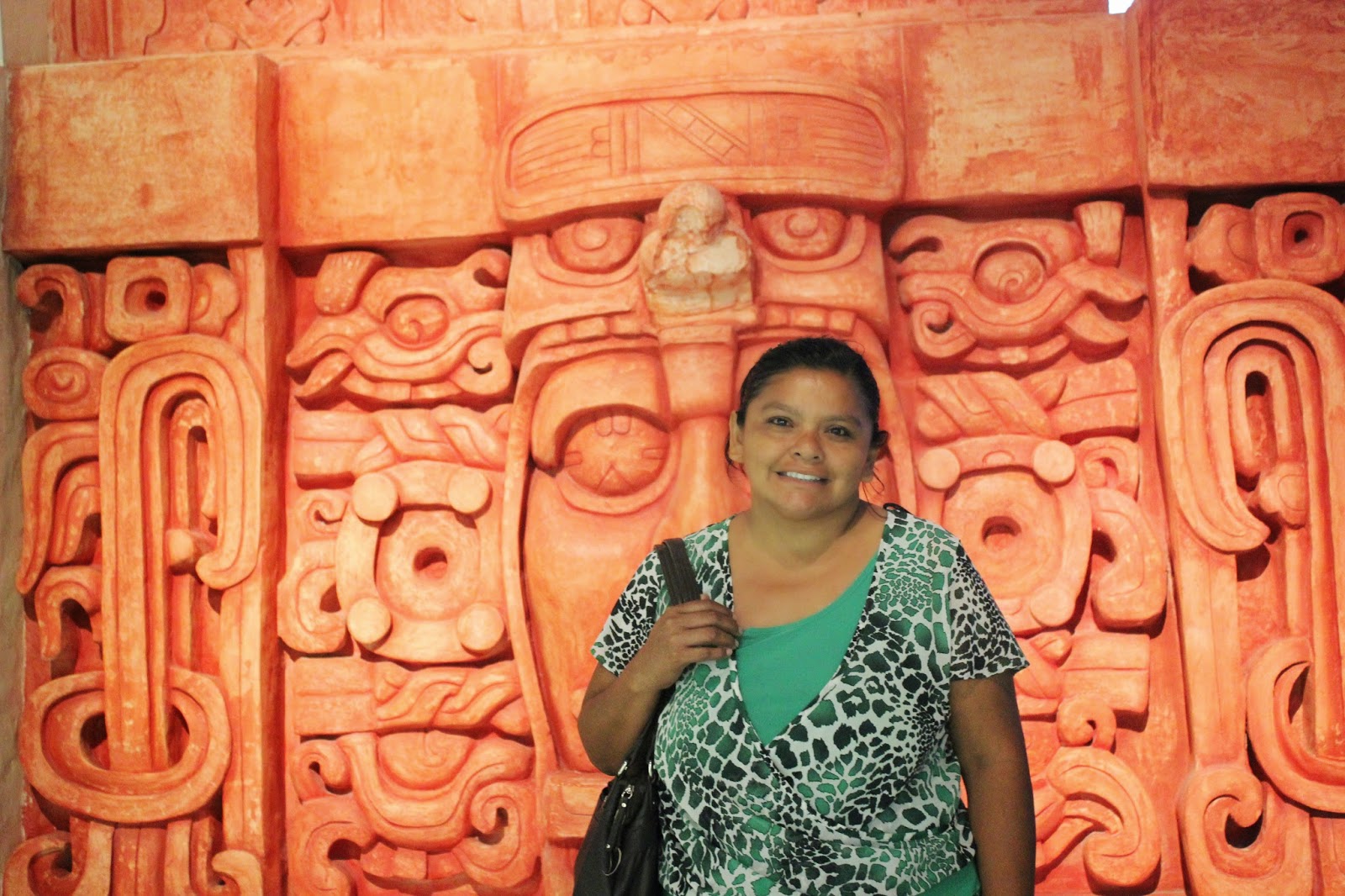
As I continued along my Maya educational journey, I went to a first rate museum (as I am a museum-goer in every city). The Gran Museo del Mundo Maya (Great Museum of the Maya World) covers the history of a local people. And, not only did I get to take in as much learning and history of Maya as I could stand in one morning, I was accompanied by my new friend, Proyecto Itzaes library supporter Veronika. Vero, who lives in Chicxulub Pueblo about 40 minutes from the museum, had never been. She was enthralled; Vero is Maya afterall. And while Vero's parents speak Yucatec Maya (which is a language option throughout the entire museum), she does not. Vero knew many things about the history and tradition of the Yucateco Maya, but she told me afterward she learned a lot at the museum.
Vero in the Gran Museo del Mundo Maya in Mérida, Yucatán

My hope is that Vero can take her kids to the museum next time. And that she and her family can some day visit Chichen Itza.

To learn more about Maya legends, I recommend this website: http://www.jaguar-sun.com/links.html

Wednesday, March 26, 2014

a book snob

A room without books is like a body without a soul.
― Cicero


I did two little things. 


I decided to come to the Yucatan. I bought a ticket, packed my bags, got on a plane, and arrived here. Simple. Every day I think about how incredibly blessed I am to have the time and means to come here.


I delivered books to Chicxulub Pueblo. Again, simple. And very easy because of the infrastructure Proyecto Itzaes has set up over the past 15 years. Wonderful people and a dedicated leadership system has keep the Chicxulub Pueblo Proyecto Itzaes library thriving.


The welcoming entrance to the library in Chicxulub Pueblo

Books change lives. I know it sounds cliche, and if you know me personally, you've probably heard it at least a dozen times from my mouth directly. I am a product of books (and public libraries). The world I enter every time I read a book is a world of discovery and learning. But it's also a world I create, pictured in my head the way I see it. It's not one director's interpretation, picking the characters he sees and showing them to me. When I read a book, it belongs to me. And I couldn't be happier. I have something of my own.


I didn't just grow up in a typical household with books, school, and sports teams. I grew up with a mother whose consistent involvement in two specific activities spanned my entire life. The first is volunteer. From CASA to big sister, my mom is the essence of volunteerism. And from whom (I hope) I developed my lifelong commitment to service.


The second is my mother (and my father) are readers. And they took me to the library. Every single day. I am not just a typical occasional reader; I'm a reader. I've even been called a book snob (but only by my older brother). I'd rather be a book snob than have specific opinions on any other topic.


A lifetime of books has been the greatest gift. And as such, I choose to pay it forward. I give books to my niece and nephew, to my friends, and even to complete strangers. Books need to be off the shelves and out into the world. 


Because when I give a book, I get to give a journey. It's a conduit to a different world; often times, a completely new world. And thus I go, to the other side of the world (almost), giving out books. In return, I am welcomed by hungry little minds. I'm continually astonished by what one book (or 10 or 50 books) can do. I opened one book in the Proyecto Itzaes library, and before I knew it, four little bodies morphed into giant minds. A two year old yelled out every animal on the page, and then proceeded to turn every single page for me.


Budding readers in the making.

Every day, a new reader is born. It is my job to provide each reader with books. And I plan to keep doing my part.

For more information about Proyecto Itzaes and the amazing work they do in the Yucatan, check out http://wp.proyectoitzaesusa.org/